Subtitle: T-money (Pay-as-you-go) vs. Climate Card (Unlimited). We break down the math for your 2026 Seoul trip.
A New Way to Travel Seoul
Welcome back to SimpleLifeStories in Korea!
In my last post, we talked about the T-money Card, the trusty “reloadable wallet” that has been a travel essential in Korea for over a decade. For years, the rule was simple: Buy a T-money card, load it with cash, and pay for every ride you take.
But recently, the game has changed.
If you are planning a trip to Seoul in 2026, you might have noticed a new card with a unique name: the “Climate Card” (Gi-hu-dong-haeng-card).
Despite the eco-friendly name, for travelers, this card means one powerful thing: Unlimited Rides.
Think of it this way:
- T-money is like buying a movie ticket every time you watch a film.
- Climate Card is like a Netflix subscription—you pay a flat fee once, and you can ride as much as you want.
Suddenly, travelers have a choice. Is the freedom of unlimited rides worth the price? Or is the classic T-money still the smarter choice for your budget?
As a local living in Korea, I have tested both. Today, I will introduce you to this new “Climate Card” and help you decide which pass belongs in your pocket.
1. The Contenders: A Quick Overview
Before we do the math, let’s understand the vibe of each card.
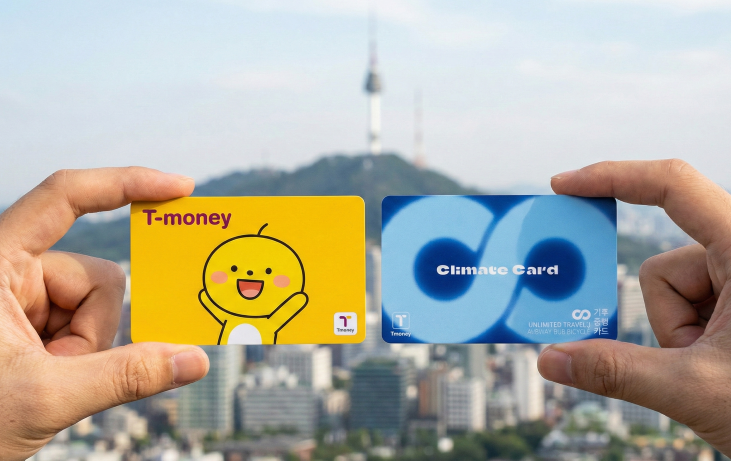
The Classic: T-money Card
Think of this as your digital wallet. You buy a blank card (usually decorated with cute characters like Kakao Friends), load it with cash, and pay for every ride you take.
- Pros: It works everywhere—buses, subways, taxis, and even convenience stores. It covers the whole country (Busan, Jeju, etc.).
- Cons: You have to keep reloading it. If you run out of balance during rush hour, it can be stressful.
The Challenger: Climate Card (Tourist Pass)
This is Seoul’s “All-You-Can-Ride” ticket. You pay a flat fee upfront, and the city is yours.
- Pros: Unlimited rides on Seoul subways and buses. Zero stress about getting lost or taking the wrong train.
- Cons: It works only in Seoul (not for trips to Busan or the airport railroad express).
2. The Math: 2026 Price Breakdown
Let’s get practical. As of 2026, the base fare for the Seoul Subway is 1,550 KRW.
Here is the price list for the Climate Card Tourist Pass (Physical card cost: 3,000 KRW separate):
- 1-Day Pass: 5,000 KRW
- 2-Day Pass: 8,000 KRW
- 3-Day Pass: 10,000 KRW (Best Value)
- 5-Day Pass: 15,000 KRW
- 7-Day Pass: 20,000 KRW
The “Break-Even” Point
If you buy the popular 3-Day Pass (10,000 KRW), the daily cost is roughly 3,333 KRW.
- Scenario A: The Slow Traveler (2 rides/day)
– Morning: Hotel → Cafe. Evening: Cafe → Hotel.
– T-money Cost: 3,100 KRW.
– Winner: T-money. - Scenario B: The Explorer (3 rides/day)
– Morning: Palace tour. Lunch: Trip to Bukchon. Dinner: Hongdae.
– T-money Cost: 4,650 KRW.
– Winner: Climate Card.
Verdict: If you plan to ride the subway or bus 3 times or more per day, the Climate Card is mathematically superior.
3. Beyond the Money: The “Freedom” Factor
This is where the Korea local life perspective comes in. The true value of the Climate Card isn’t just saving 1,000 won—it’s the peace of mind.
Imagine you take the bus, but realize you are going the wrong way (it happens to all of us!).
- With T-money: You get off, cross the street, and pay again. It feels like a waste.
- With Climate Card: You laugh, hop off, and take the next bus. No extra cost.
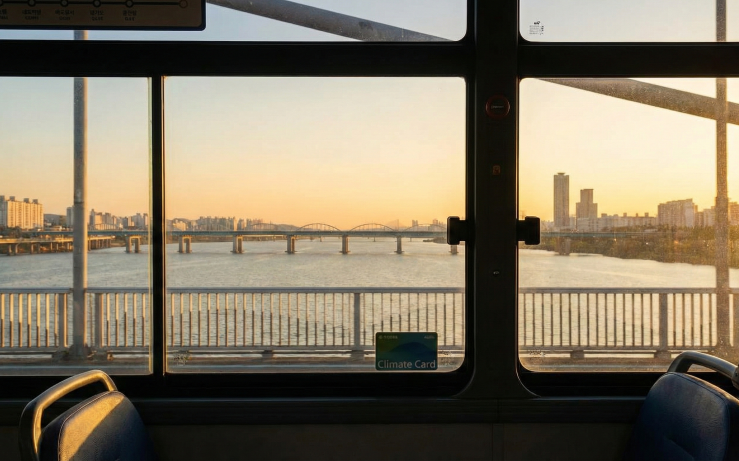
Seasonal Experiences with Unlimited Rides
Korea has four distinct seasons, and your transit card actually helps you enjoy them better.
- Spring (March-May): The weather is perfect. You can take short bus hops between cherry blossom spots like Yeouido and Seokchon Lake without worrying about accumulating fares.
- Summer (July-August): It gets incredibly hot and humid. With an unlimited pass, the bus becomes your moving air-conditioned shelter. Even if you only need to go two stops, hop on the bus to escape the heat!
- Autumn (September-November): Perfect for hiking. Take the subway to the base of Bukhansan Mountain, hike, and take a bus back to a sauna.
- Winter (December-February): When the biting wind hits, you won’t want to walk 15 minutes to the station. You can transfer freely from bus to subway to minimize outdoor exposure.
4. Essential User Guide & Etiquette
To blend in with the locals and avoid awkward moments at the turnstile, keep these tips in mind.
The “Calendar Day” Rule (Crucial!)
The Climate Card follows the calendar, not a 24-hour clock.
- Don’t: Activate a 1-Day pass at 9:00 PM. It will expire at midnight, giving you only 3 hours of use.
- Do: Activate it first thing in the morning (e.g., 9:00 AM) to get the full day’s value.
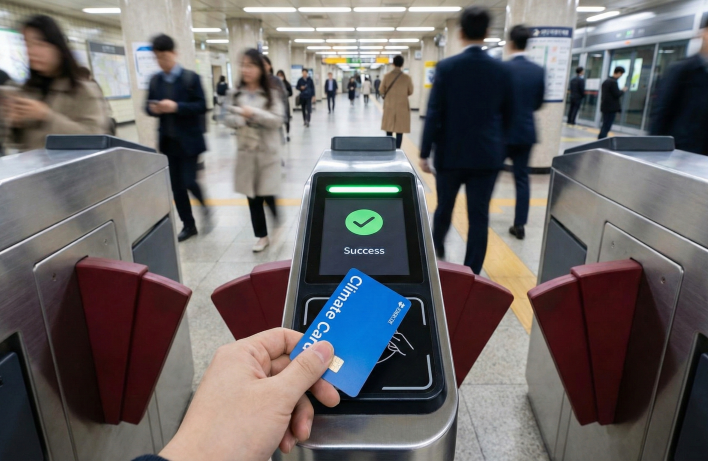
“Tag In, Tag Out”
In Korea, you must tap your card when you enter AND when you exit—even on buses.
- Why? Distance-based fares are calculated this way.
- Etiquette: Have your card ready before you reach the gate to avoid blocking the busy rush-hour crowd (the Ppalli-Ppalli or “Hurry-Hurry” culture is real during commute times!).
Buying & Charging: Cash is Still King
While Seoul is high-tech, transit machines can be old-school.
- The Issue: Many ticket machines reject foreign credit cards.
- The Fix: Always carry 10,000 KRW cash bills. You can buy the physical Climate Card at convenience stores (GS25, CU) near stations, but you usually need to top it up at the machine inside the station.
Simple Life Tip: If you want to keep your hands free while exploring, I highly recommend getting a phone case with a card slot or a simple MagSafe card holder. Fumbling through your bag for your pass every time you transfer can be exhausting!
5. Summary: Which One Should You Pick?
Here is my final recommendation for your 2026 trip:
Choose T-money if:
- You are staying in one neighborhood and mostly walking.
- You plan to visit other cities like Busan or Jeonju (one card for the whole country).
- You take taxis often (you can pay for taxis with T-money!).
Choose Climate Card if:
- You are an active traveler visiting 3+ spots a day.
- You want the freedom to get lost and explore without thinking about costs.
- You are staying strictly within Seoul.
Your Next Step
If you decided on the Climate Card, make your first stop at a GS25 or CU convenience store right after checking into your hotel. Ask for the “Climate Card” (Gi-hu-dong-haeng-card).
Wait! Did you choose T-money? If the Climate Card math doesn’t work for your schedule, stick to the classic T-money. It’s still the most flexible option for light travelers. I wrote a full guide on how to use it without getting confused at the station.