Happy New Year! But wait, if you are in Korea, you might have just gotten one year older, even if your birthday is months away. Confused? Welcome to the unique and slightly chaotic world of “Korean Age.”
In Korea, you don’t just blow out candles to age up. You have to eat a bowl of special soup on Lunar New Year’s Day (Seollal). Today, I’ll share some Deep K-Insights on this tradition and clarify the confusion regarding the recent law changes.
1. The Confusion: “International Age” vs. “Korean Age”
Here is a fact that confuses many visitors: Korea currently has two age systems coexisting.
A. The Official Standard: “International Age”
In June 2023, the Korean government officially adopted the global standard.
- We call this “Man-nai” in Korean, but it simply means “International Age.”
- It works exactly like yours: you start at 0 and turn one year older on your actual birthday. Legally, all Koreans are now the same age as you would calculate in the US or Europe.
B. The Traditional Custom: “Korean Age”
However, culturally, old habits die hard. In casual conversations, many Koreans still use the traditional “Korean Age” system.
- How it works: You are considered 1 year old the moment you are born. And everyone turns one year older together on New Year’s Day (not on their birthday!).
- The Reality: So, legally we follow the International Age, but socially, we often stick to the “Korean Age” to decide who is the “older brother/sister” (Hyung/Unnie).
💡 Pro Tip for Travelers: If a Korean asks your age, it can be tricky. The safest answer? Just say your Birth Year.
- Example: “I am an 85-liner (born in 1985).” This avoids all confusion!
2. Solar New Year vs. Lunar New Year (When do we eat?)
Another confusing part for foreigners is that Korea has two New Years.
- Solar New Year (January 1st): Ideally, the “number” of your age changes here. Many Koreans briefly celebrate this day (called Sinjeong) and some eat the Tteokguk.
- Lunar New Year (Seollal, Usually Jan/Feb): This is the “Real Traditional Holiday.” Even if you turned one year older on Jan 1st socially, the official ceremony of eating Tteokguk with your whole family happens now.
3. Tteokguk: The Soup That Gives You Age
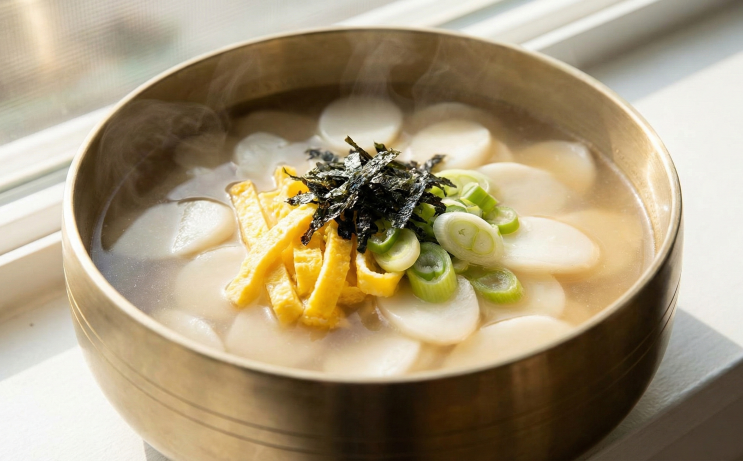
On Seollal morning, the smell of savory beef broth fills every Korean home. This is Tteokguk (떡국 – Sliced Rice Cake Soup).
- Why White & Long? The main ingredient is Garaetteok (long, white cylinder rice cake). It symbolizes a long, healthy life and purity.
- Why Coin Shape? We slice the long rice cakes into thin round shapes that look like coins (Yeopjeon). This represents a wish for wealth and prosperity in the new year.
There is a famous saying in Korea: “Did you eat Tteokguk?” This question literally means, “Are you a year older?”
4. How to Experience This at Home (Deep Insight)
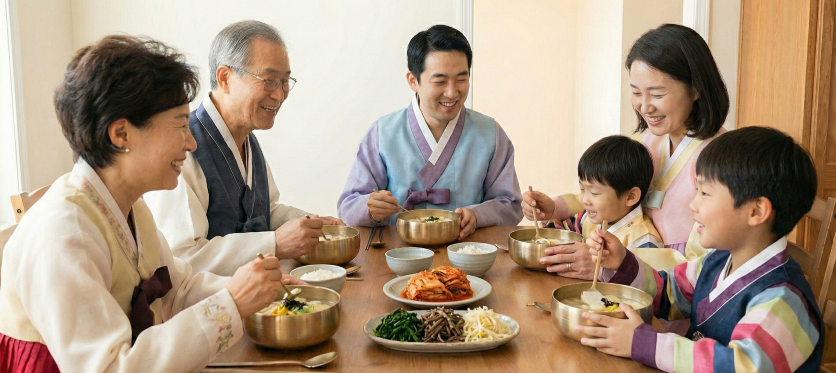
You don’t have to be in Seoul to experience this tradition. Tteokguk is surprisingly mild, chewy, and savory—a perfect comfort food for winter.
If you want to try gaining a “Korean Year” (or just want a delicious meal), you can easily make it at home.
- The Easy Way: Look for “Tteokguk Meal Kits” online. They usually come with the beef broth base and sliced rice cakes.
- The Authentic Vibe: To truly feel like a Korean noble, serve it in a traditional brass bowl (Bangjja Yugi). It keeps the soup warm until the last drop.
Conclusion
Korean age might seem complicated with the mix of new laws and old traditions, but it’s ultimately about community. We age together, and we share a warm meal together.
This Lunar New Year, why not try a bowl of Tteokguk? You might not legally get older, but you will definitely feel warmer and wiser.